Harmonica Q&A | MP3 | Feedback | "Meet Your Picker" | Free Stuff | Back Issues "Meet
Your Picker" Meet Your
Picker Have you
ever wondered why right handers pick with the right
hand, since the left hand seems to be the one on
which most learners concentrate, and with which
they have the most trouble? Why not put the
difficult stuff into the hand with the most
"dexterity," i.e., the dominant hand: For most of
us, the right. It's the
picking hand that makes the sound. Timing,
expression, rhythm, feeling is primarily functions
of precisely when the note is hit, the shape &
volume of the note and how it is struck. Is a note
exactly on time (steady & strong), or a little
early (lively), or late (laid back)? Is the attack,
that is, the first part of the note, strong or
soft? Does the note sustain or break off? What is
the shape of the note? Is it loud or soft compared
to its neighbors? Is it edgy or smooth? Is it
consistent with what's happening or out of
place? Imagine
that you had no control at all of the subtleties of
the right hand. Imagine that every note was exactly
on time and had the same shape, volume and
duration. Boring. Now imagine that you only had a
few pitches with which to work, like on a drum or a
kalimba. Imagine that you struck each note
skillfully and with feeling. You'd have a
groove. Imagine
that you are playing a song with a group and things
are going along smoothly. Now instead, imagine you
miss an E and get a D# instead. But you stay with
the groove, stay on time and the D# gets along with
its neighbors in terms of volume and sustain. You
get right back to key the very next note and the
groove lives on. Probably no one even noticed.
Maybe they think you were being creative. The wrong
note is the left hand's problem. The wrong feel or
tempo is the right hand's. Melody,
harmony, composition, lyrics, instrumentation . . .
the list is endless if you start trying to define
the components of music. But the roots are rhythm
and voice. It's the right hand that gives rhythm
ands voice to your sound. Say hi to it. Refresh
your acquaintance. Help it along. Try this
exercise on your guitar or bass. Keep your fret
hand off the fretboard. Use only open strings with
a 4/4 metronome background. Try getting a groove
going with just one string at first. Then use 2, 3.
. . . Try slow simple patterns at first, then
increase speed and complexity. But ALWAYS listen to
the timing and shape of the notes. You can do this
finger style or use a pick. It doesn't matter.
Whatever style of playing you want to work on. See
how long it takes to get something musical to
happen, and see how long it takes before you lose
the groove (or get bored). Try muting the strings
with a rubber band or a rag, and do the same with
even less tonality. My guess is that you'll be
surprised at first at how many weaknesses you
notice when you truly focus your attention on your
picking alone. I would also guess that if you stay
with this line of practice regularly you would
notice great improvement in your musicality when
you get back to your normal routines and
songs. If you run
out of practice time, like we all sometimes do, you
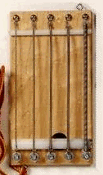
can do the above exercises on a little rig called
the Twanger PraxAx. It's made to reproduce the feel
of the strings at the picking hand position. It's
small enough to carry in a pocket. It comes with a
belt so you can wear it. This lets you use it with
the right hand while the left hand remains free.
Use it while commuting, during downtimes at school
or work, while on the phone or computer. It is fun
and relaxing, after you get used to the strangeness
of only using one hand. It helps relieve road rage,
shopping stress and fear of flying. Check it out at
www.twanger.com The
Twanger PraxAx is available in many
versions: All
versions are also available as an electrified
model. See www.twanger.com
for more information, and to order this innovative
practice tool. 
ISSN: 1529-0956
Library Of Congress, Washington D.C. USA |

Play It Again Sam . . 66 Main St . . Montpelier VT 05602 . . Phone (800) 472-SAMS . . Fax (802) 229-0755