Harmonica Q&A | MP3 | Feedback | "Bending Steel" | Free Stuff | Back Issues Edly:
Music Theory
Edly, Would you
mind answering another question for me? This one is
definitely about something that's been tougher for
me to grasp. It's tough to even verbalize in the
form of a question. This has to
do with the chord symbols floating about the bars I
encounter on sax music. It's not to be confused
with how chords are actually written out for piano
music. I see that sax sheet music often has the
chord progressions above the bars. Of course that
music will also have a key signature. But the key
signature doesn't really have any effect on reading
the chords do they? I mean, a chord written above,
such as Dm, already specifies the root as D. If I'm
playing the piano (or arpeggiating with the sax),
won't I simply hit the the notes together as D, F#,
A? Or am I supposed to bring the key signature into
the equation? For example, if the key signature was
Eb, would that make Dm a relative designation (like
IIm)? In other words would the root then be based
on where D lies on Eb relative to its location on C
major(like F A C I think)? If the
chords are played as written, regardless of the key
signature, then how would you transpose them to a
different key? Say if the piece was in C and you
wanted to transpose it to Eb, what would D, F#, A
of Dm then become? I knew
nothing about music until I picked up your book so
the fact that I can even phrase a music question is
testimony to the efficacy of your book. I've come a
long way. ________________________ Chris, Very cool
question!! But before
I answer it, let's fix two mistakes: Dm is D F A,
not D F# A. And a Dm chord in the key of Eb would
be a viim, not a iim--you analyze chords relative
to the key signature of the song, not relative to
C. To boil
down your question: Does the key signature have any
effect on reading the chords? No. A Dm is
D F A regardless of the key signature. Short
answer to your transposition question: A Dm in the
(original) key of C would be an Fm in the (new) key
of Eb. It's iim in both cases. You've come
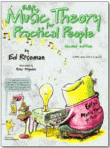
a long way baby. I'd encourage you to reread the
book, though. Most people miss a lot in one
reading. Maybe it's my fault as the author, or
maybe it's just due to the amount of material
covered (or maybe it's like a good movie: the
second time through, you notice all those nifty
details you missed the first time). In your
case, I recommend reviewing the chapters on chord
construction, major scales and keys, diatonic
chords, and transposition. Your transposition
question is answered more fully there. Edly To get your
head keyed in the right direction, visit Edly's
website Beam
your music theory questions to us at
askedly@guitarsam.com
ISSN: 1529-0956
Library Of Congress, Washington D.C. USA |

 What
is music theory, anyway? You hear so much
about it, but does anybody really know what it
is? Edly does!

Play It Again Sam . . 66 Main St . . Montpelier VT 05602 . . Phone (800) 472-SAMS . . Fax (802) 229-0755